The Stones of the Gulf
Pearl, agate, malachite, turquoise, rose quartz and amethyst: what they are, and what they do on the skin.
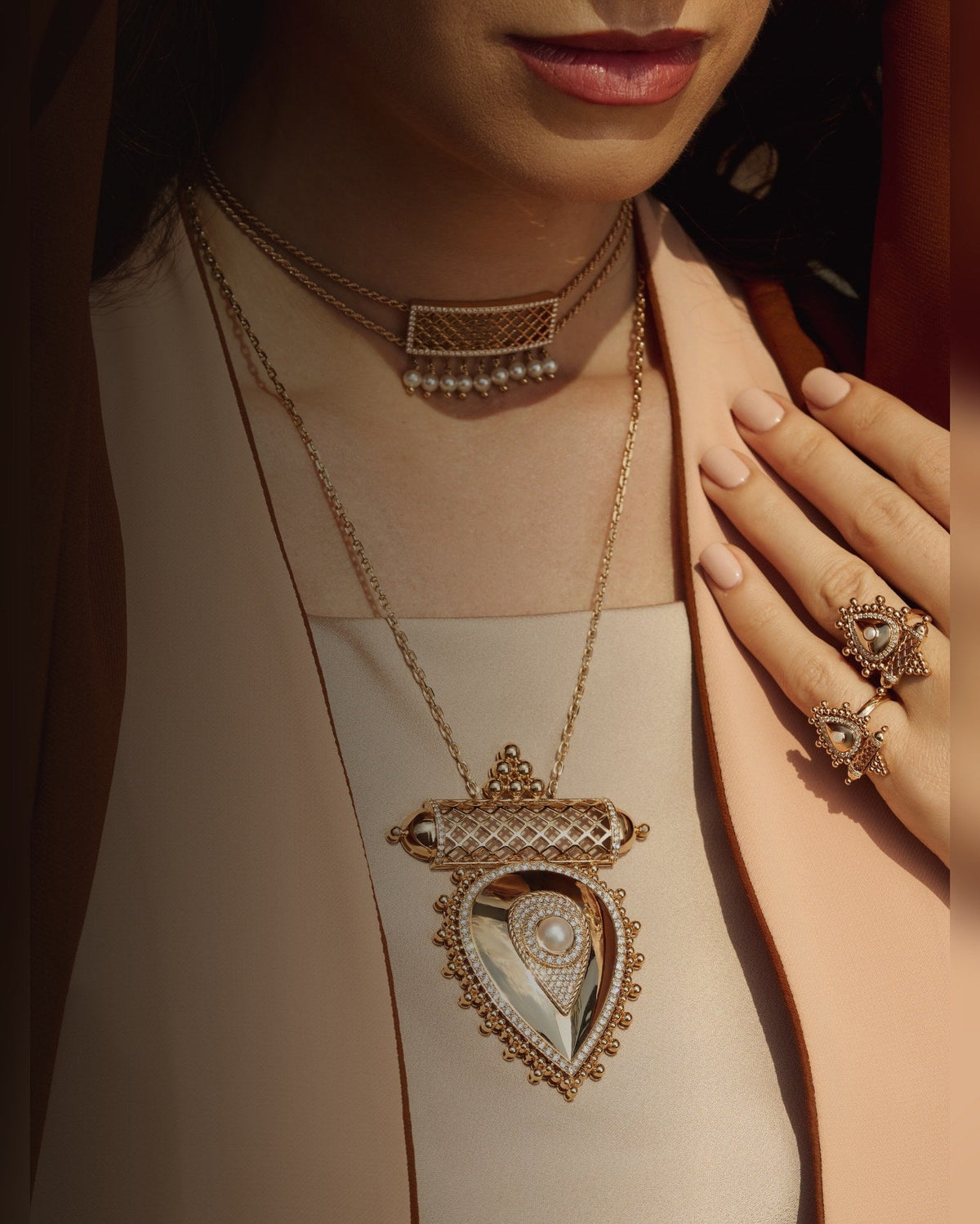
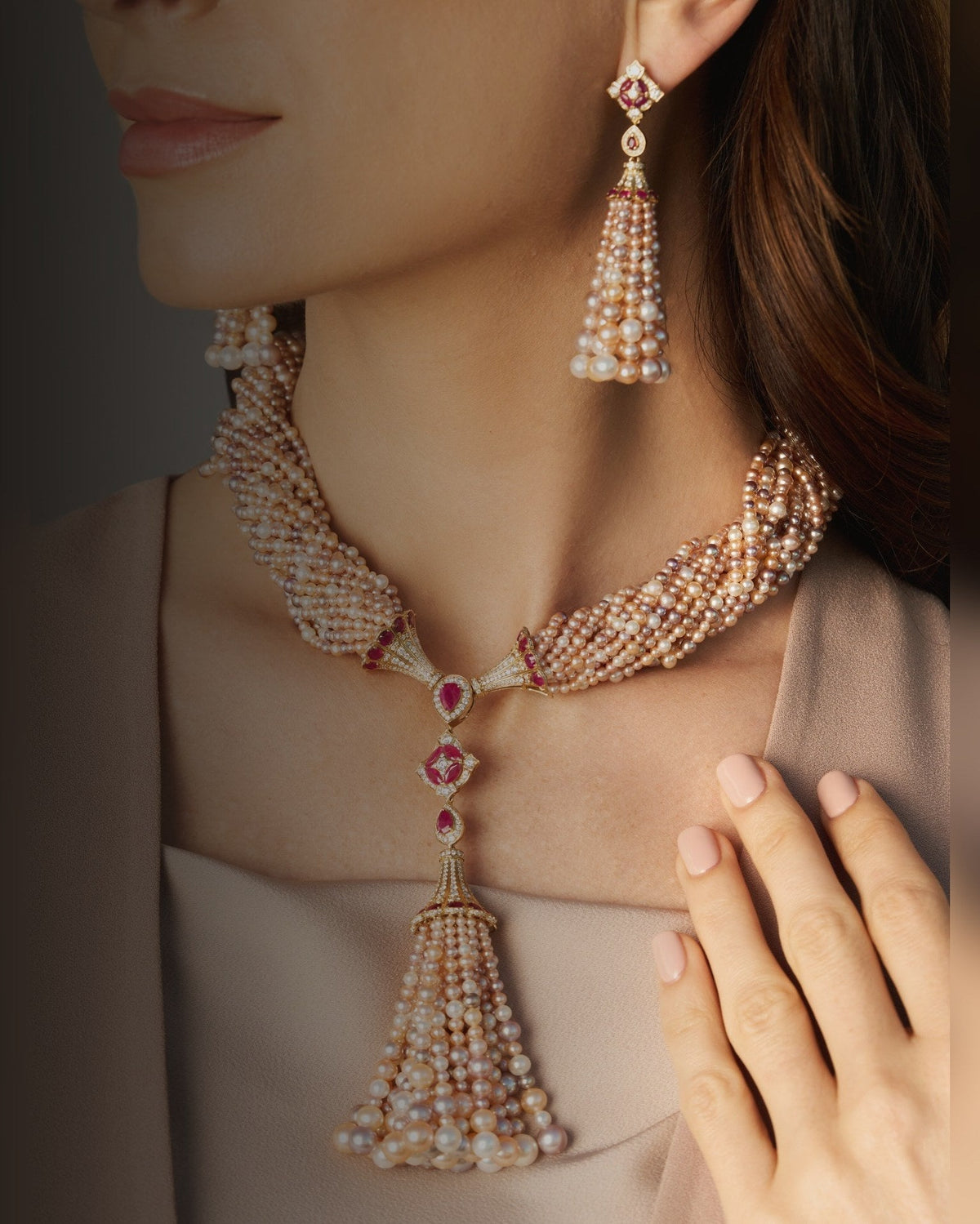
Walk through a gold souk in the Emirates and you will see the same stones again and again. Not the stones that dominate European fine jewellery, but a quieter family: the milky sheen of pearl, the banded layers of agate, the deep green of malachite. They are not here by accident. They are the stones this coast has traded, worn and valued for centuries, and they are the foundation of our Heritage and Al Qasr collections.
Pearl and mother-of-pearl
No stone is more tied to this region. Before oil, the Gulf lived from pearling: fleets left the ports of Abu Dhabi, Dubai and Bahrain each summer, and divers worked the beds in the shallow waters between here and the Qatari coast. The trade collapsed in the twentieth century, but the pearl stayed in the jewellery, and it stayed in the stories.
What is the difference between pearl and mother-of-pearl?
They are the same material in different forms. A pearl is formed inside the shell as layers of nacre build around an irritant. Mother-of-pearl is that same nacre lining the inside of the shell itself, cut and shaped into flat forms. Pearl gives you a sphere, mother-of-pearl gives you a surface, which is why it can be set as a wide, luminous face in a pendant.
How it behaves
Both are organic and both are soft. They pick up the warmth of the skin, and they shift slightly with the light rather than flashing like a faceted stone. They are also the most delicate things we set: no perfume, no chlorine, no ultrasonic cleaning, ever.
Agate
Agate is a banded form of quartz, built up in layers over an enormous span of time, which is why each piece carries its own striped pattern. It has been carved and worn across Arabia and Persia for millennia, often as a protective stone.
How it behaves
Agate is the most forgiving of the stones we use, harder than pearl and less fragile than malachite. The pleasure of it is the banding: because every stone is cut individually, the pattern inside a Heritage pendant is unrepeatable. It is the clearest example of why two pieces of the same design are never quite the same object.
Malachite
The deepest green of the family, and the most dramatic, with concentric bands that look like rings in a cut tree. It has been mined and traded for thousands of years and ground into pigment long before it was set into jewellery.
How it behaves
Malachite is beautiful and genuinely delicate. It is soft, it is porous, and it reacts badly to acids, heat and ultrasonic cleaners. Treated carelessly, it loses its depth and becomes chalky, and that cannot be reversed. Treated properly, which means a dry cloth and nothing else, it keeps its colour indefinitely.
If you remember one thing: malachite and turquoise should never meet water, perfume or a cleaning machine. A soft dry cloth is the whole method.
Turquoise
Turquoise travelled into the Gulf along the old trade routes from Persia, where the finest material has been mined for thousands of years. Its blue sits somewhere between sky and sea, often veined with the dark lines of the rock it formed in.
How it behaves
Porous, and more than most people expect. Turquoise absorbs oils, and it can shift colour over the years as it takes up what it touches. Some owners like that, seeing it as the stone recording the life it has had. If you would rather it did not, keep it away from hand cream and perfume.
Rose quartz
The gentlest colour of the group, a soft translucent pink, and traditionally the stone associated with affection rather than status. It is a quartz, like agate, so it is reasonably robust.
How it behaves
Rose quartz holds up well to daily wear, with one exception: prolonged direct sunlight fades it. A piece left for weeks on a windowsill will not come back.
Amethyst
Purple quartz, and for most of history one of the most valuable stones in the world, until large deposits were found in South America and the price fell. The colour remains what it always was.
How it behaves
Harder than malachite or turquoise, and so easier to live with. Like rose quartz, it fades in strong sun over long exposure, and like all our stones it prefers a dry cloth to any kind of bath.
Choosing between them
- For a first piece in natural stone: agate. It is the most robust, and the banding makes it interesting on a plain day.
- For something that reads as formal: pearl or mother-of-pearl, which carry the region's history more directly than anything else.
- For colour that announces itself: malachite, with the care it demands.
- For something quiet: rose quartz, which sits close to the skin tone rather than against it.
All of them are set in 18k gold and handcrafted in the United Arab Emirates. You will find them across Heritage and Al Qasr, in rose, white and yellow gold.
Common questions
Are the stones in Misk jewellery natural?
Yes. Agate, malachite, pearl, mother-of-pearl, turquoise, rose quartz and amethyst are natural stones, which is exactly why no two pieces of the same design look identical.
Which Gulf stone is the most durable?
Agate, rose quartz and amethyst are all quartz and handle daily wear well. Malachite and turquoise are the softest and the most porous. Pearl and mother-of-pearl are organic and the most delicate of all.
Why is pearl so important in Emirati jewellery?
Because pearling was the economy of this coast before oil. Fleets from the Emirati ports worked the Gulf beds every summer, and the pearl became the region's emblem. Wearing it is a reference to that history, not only a choice of colour.
Can I swim wearing a stone-set piece?
No. Chlorine and salt water both damage porous stones, and sand acts as an abrasive on the gold around them. Take the piece off before you go in.